
Deep Work vs Pomodoro: Which Should You Use?
Deep work means long uninterrupted blocks; Pomodoro means short 25-minute cycles. Here's when each fits, why they aren't competing, and how to combine them.
 CollinFounder, OneTabFocus9 min read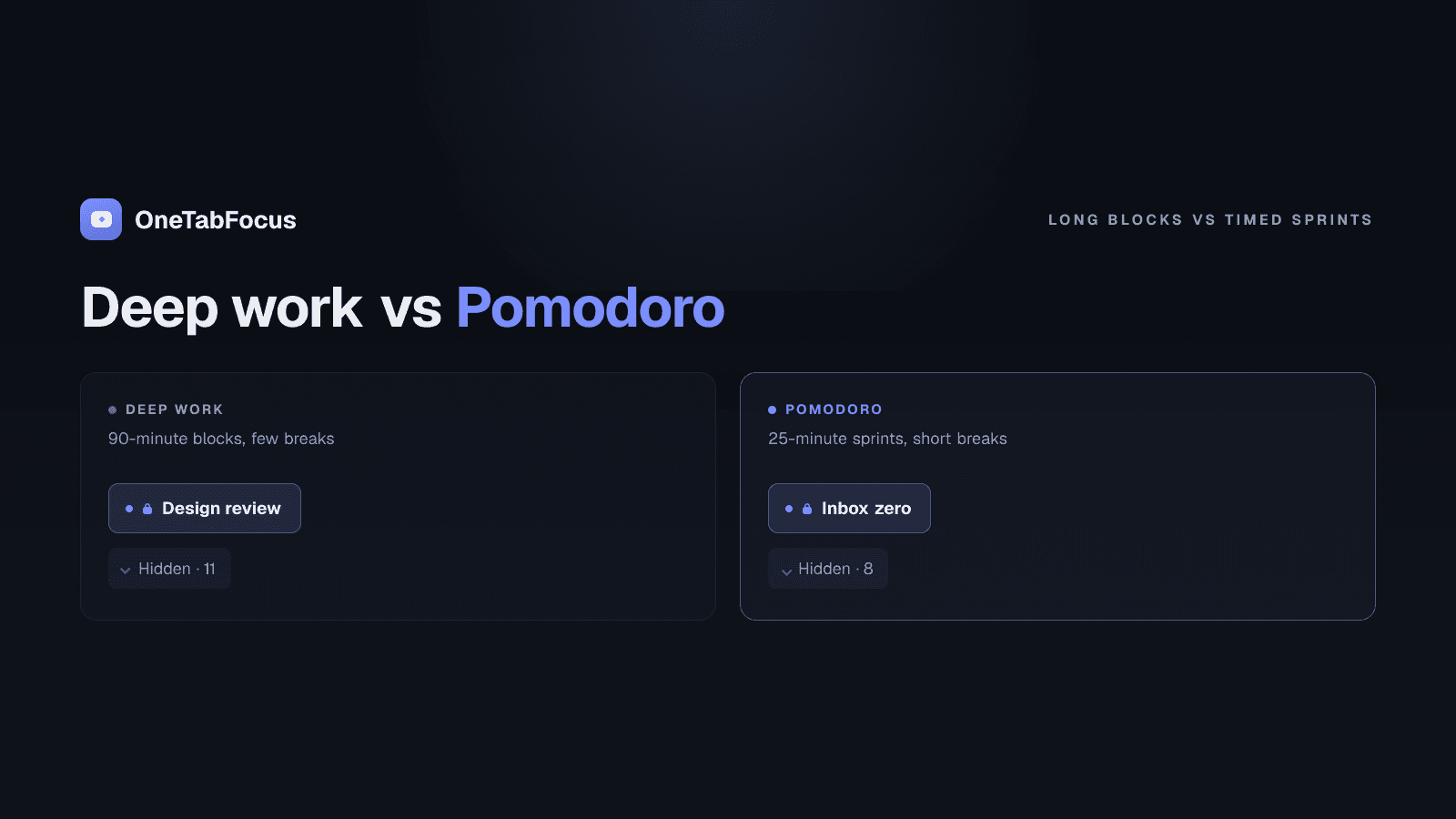
On this page
The two methods, side by side
Deep work and Pomodoro are often presented as alternatives — pick one. They aren't, really. They are different things at different scales, and the "vs" framing usually means the writer is comparing the wrong axes.
Deep work is a category of activity, defined by Cal Newport in his 2016 book Deep Work as "professional activity performed in a state of distraction-free concentration that pushes your cognitive capabilities to their limit." The defining property is depth — full attention on cognitively demanding work, with the duration whatever you can sustain. Newport's own practice is three to four hours per day, usually arranged in two morning blocks of 60 to 120 minutes each, and pairing the block with a real Pomodoro mode is the synthesis this post argues for.
Pomodoro is a time-management technique invented by Francesco Cirillo in the late 1980s. The defining property is rhythm — 25 minutes of focused work, 5 minutes of break, repeated four times, then a longer 15- to 30-minute break. Cirillo's central rule is that a Pomodoro mode is indivisible: you don't pause it, you don't extend it, and you take the breaks as written. The technique is content-agnostic; you can run a Pomodoro on email triage or on writing a novel.
The two answer different questions. Deep work answers "what kind of activity should I be doing for serious output." Pomodoro answers "how do I structure my focused time so I actually start and don't burn out." A two-hour deep-work session can use Pomodoro structure inside it. A Pomodoro can be deep or shallow depending on the task it contains.
What each method optimizes for
The "vs" comparison gets clearer when you name what each method is actually optimising for.
Deep work optimises for depth. Newport's argument is that uninterrupted concentration past the first 15-to-20-minute warm-up is where the most valuable cognitive work happens. Sophie Leroy's research on attention residue supports this — switching out and back leaves cognitive residue that degrades the work even after you return, so longer continuous blocks produce more usable output than the same total minutes broken up. A 90-minute uninterrupted block is not the same as three 25-minute blocks with breaks between them.
Pomodoro optimises for starting. The genius of the 25-minute interval is that it is short enough to commit to on a bad day. "Write the report" is a vague open-ended commitment your brain can defer indefinitely. "Write the report for 25 minutes" is a concrete time-bound game. Once you start, the second Pomodoro is easier than the first, and most people who can complete one Pomodoro will complete the four. The method's real intervention is at the activation-energy step, not at the sustained-attention step.
The implication: if your problem is starting, Pomodoro is the better tactic. If your problem is reaching depth, longer uninterrupted blocks are better. Most people who think they have a focus problem have a starting problem first and a depth problem second — fix starting and the depth follows.
When deep work is the right choice
Use long uninterrupted blocks (60 to 90 minutes, sometimes 120) when:
- The work needs runway. Writing, design, debugging, strategic analysis, original research — anything where the first 15 minutes are mostly loading context into working memory. Breaking that runway with a Pomodoro switch costs you the loading effort twice.
- You can reliably start. If you sit down and begin the work without 20 minutes of warm-up procrastination, you can skip the Pomodoro scaffolding and go straight to the longer block.
- You're in your best window. Most people have one or two windows per day (often early morning) where they can sustain real depth. Use those windows for the longest blocks you can defend.
Newport's three-to-four-hour daily ceiling for sustained deep work is the upper limit; most blocks will be 60 to 90 minutes within that.
When Pomodoro is the right choice
Use 25-minute Pomodoro cycles when:
- You're struggling to start. The shortest interval that still produces meaningful output. The whole technique is designed around the activation-energy problem.
- The task is naturally chunkable. Email triage, code review, sourcing decisions, admin work, study sessions on bounded material. Each Pomodoro can finish a real unit of work.
- You're new to defended focus blocks. Pomodoro is the right first step. Start with one or two Pomodoros a day for two weeks; build to longer blocks once the Pomodoros are reliable.
- It's late in the day. Cognitive capacity is depleted; you can't reach the same depth you would in the morning. A short Pomodoro on a smaller task is more achievable than a long deep-work block that you'll fail to hold.
A 2026 Brown Daily Herald fact-check found students using systematic break-taking techniques like Pomodoro reported being more concentrated and motivated than peers choosing their own break schedules. The method works; the question is whether it's the right method for your specific task.
The synthesis: Pomodoro inside a deep-work block
The strongest setup for most knowledge workers is a 90-minute deep-work block that internally uses Pomodoro structure — three 25-minute focus phases separated by short breaks, with a longer break at the end before the next block.
The benefits of both methods compound:
- The Pomodoro structure makes starting trivial — you commit to 25 minutes, not 90.
- The longer total block delivers the runway Newport's research requires for depth.
- The breaks between Pomodoros catch the cognitive fatigue that would degrade hour two.
- The 90-minute total respects the DeskTime work-rhythm data on optimal focus-to-rest ratios.
For this hybrid to work, the lock has to hold through the Pomodoro breaks. A break that becomes a return to your tab strip breaks the rhythm and resets you to the activation-energy problem at the start of the next Pomodoro. This is the gap most Pomodoro timers leave open — they pause the count during breaks but don't enforce anything, so the break becomes a Twitter scroll and the next Pomodoro never really starts.
How OneTabFocus does both
Pomodoro mode runs configurable focus and break cycles. The lock holds through breaks — you get a pause screen, not a return to distraction. The focus phase resumes automatically.
OneTabFocus collapses every non-focus tab into a single 'Hidden' chip. Tabs are not closed: audio keeps playing, drafts are preserved, scroll position is preserved.
That is the hybrid. You start a 90-minute session, OneTabFocus locks the browser to your task tab plus your reference tabs, the Pomodoro structure runs three 25-minute cycles inside the block, the lock holds through the 5-minute breaks so the breaks are real recovery, and at the end the lock releases and your original tabs come back. For the deeper mechanics, see the Pomodoro page or the deep-work mode page. Otherwise install OneTabFocus and run one 90-minute hybrid session on whatever you have been trying to ship.
FAQ
Is Pomodoro the same as deep work?
No. Pomodoro is a 25-minute time-management interval invented by Francesco Cirillo in the late 1980s. Deep work is Cal Newport's term for cognitively demanding distraction-free activity at the limit of your capability. Pomodoro can be a vehicle for deep work — running 25-minute deep-work intervals — but the two terms describe different things at different scales.
Which is better, deep work or Pomodoro?
Neither is better in the abstract. Deep work is the goal — depth, cognitive engagement, real shipped output. Pomodoro is a tactic that helps some people reach the goal by lowering the activation energy for starting. Use Pomodoro if you struggle to start; use longer deep-work blocks once starting is reliable; combine them if the longer blocks need scaffolding.
Can you do Pomodoros inside a deep-work session?
Yes, and this is often the strongest setup. Run a 90-minute deep-work block that internally uses Pomodoro structure — three 25-minute focus phases separated by short breaks — so you get the longer total depth Cal Newport recommends with the starting-help and recovery-rhythm Cirillo's method provides. OneTabFocus is built for exactly this hybrid.
Does Pomodoro work for cognitively demanding tasks?
Yes for many tasks, but the 25-minute interval can break long-form thinking that needs more runway. For writing, design, debugging, or analysis, longer 60- to 90-minute blocks usually produce better output. For email triage, code review, or admin work, 25-minute Pomodoros are ideal. Match interval length to task depth.