
What Is Deep Work? The Beginner's Guide
What is deep work, why Cal Newport popularized the term in 2016, the four rules, the supporting research, and how to actually do deep work in a browser-heavy job.
 CollinFounder, OneTabFocus9 min read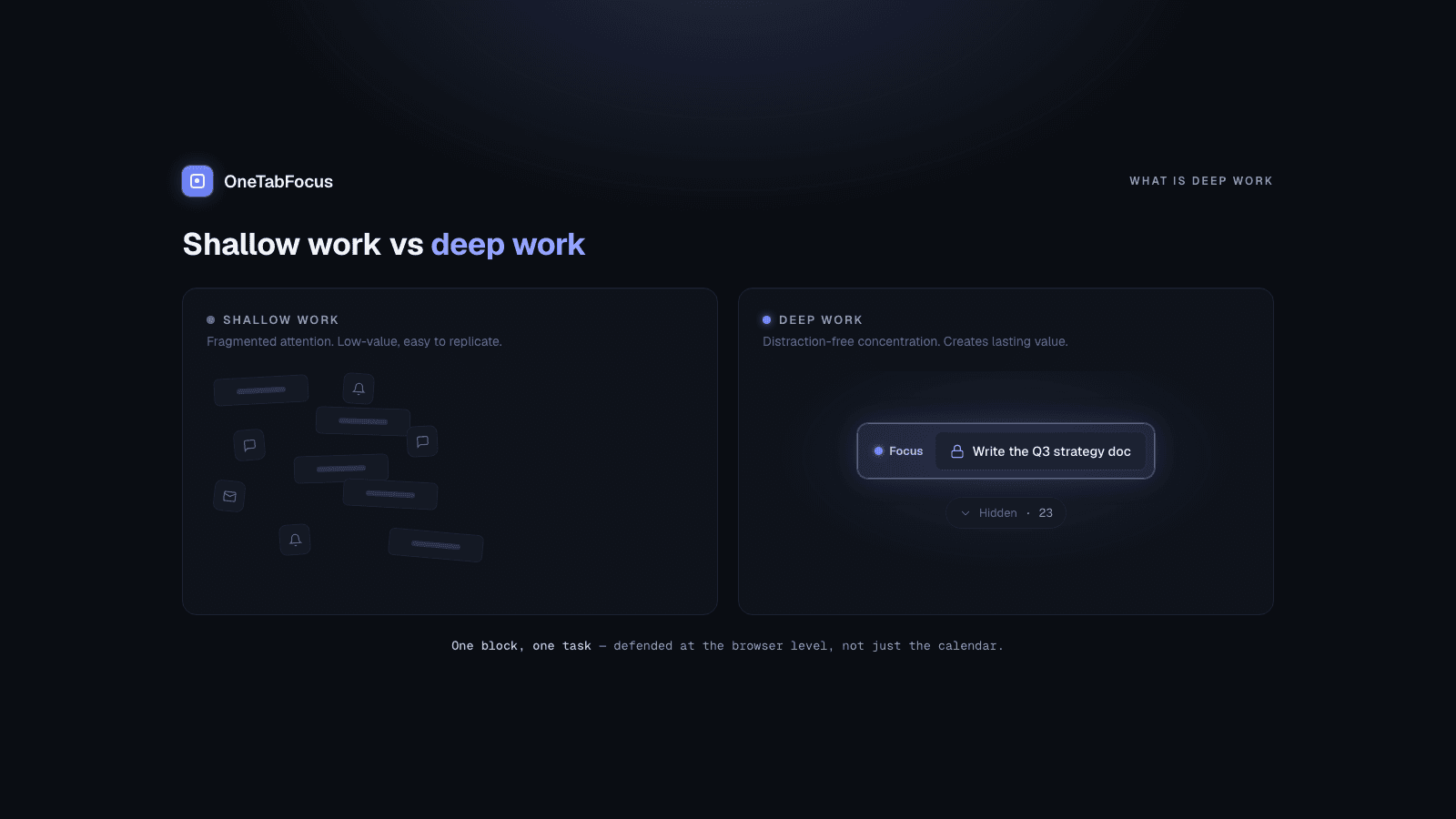
On this page
- Cal Newport's definition (the canonical one)
- Why deep work matters (Newport's economic argument)
- The four rules (Newport's Part 2)
- Rule 1 — Work Deeply (and pick a philosophy)
- Rule 2 — Embrace Boredom
- Rule 3 — Quit Social Media (or use it deliberately)
- Rule 4 — Drain the Shallows
- The supporting research Newport draws on
- Anders Ericsson on deliberate practice
- Mihaly Csikszentmihalyi on flow
- Sophie Leroy on attention residue
- How to do deep work in a browser-heavy job
- How OneTabFocus supports deep work
Cal Newport's definition (the canonical one)
The term "deep work" comes from Cal Newport, a computer science professor at Georgetown University, who first used the term in a 2012 blog post and developed its full framework in his 2016 book Deep Work: Rules for Focused Success in a Distracted World. This post is a faithful primer on the concept — definition, four rules, supporting research — and how to translate it into a deep-work mode for a 2026 browser-first job. Newport's exact definition, used verbatim across his writing and now widely cited:
"Professional activity performed in a state of distraction-free concentration that pushes your cognitive capabilities to their limit. These efforts create new value, improve your skill, and are hard to replicate."
He contrasts deep work with shallow work, which he defines as "non-cognitively demanding, logistical-style tasks, often performed while distracted. These efforts tend to not create new value in the world and are easy to replicate." Email, status meetings, slide formatting, calendar wrangling — most of what fills the modern knowledge-work day is shallow.
The distinction matters because the two categories are not interchangeable. An hour of shallow work and an hour of deep work are not the same hour. The deep hour produces lasting value and trains your capability; the shallow hour produces output that any colleague — or, increasingly, any large language model — could have produced. Newport's argument is that the proportion of deep work in a knowledge worker's week is the single best predictor of the value that worker creates over a career.
Why deep work matters (Newport's economic argument)
Part 1 of the book makes a labour-market case rather than a productivity case. Newport identifies two abilities that he argues will increasingly determine professional success in the new economy: the ability to quickly master hard things, and the ability to produce at an elite level, in terms of both quality and speed. Both abilities, he argues, are downstream of deep work. You cannot master a hard thing with two-minute attention. You cannot produce at an elite level while pulling on the same dopamine lever every other knowledge worker pulls.
The case for getting good at this is essentially supply-and-demand. The supply of people capable of sustained distraction-free concentration is dropping — Newport's own observation matches the longitudinal data on attention spans. The demand for output that requires it is rising, especially as routine cognitive work becomes automatable. That gap is the lever the post is asking you to start using, and a real deep-work mode at the browser level is one of the most practical places to start.
The four rules (Newport's Part 2)
The book's second half is structured around four rules. Each is a chapter in the book and a tactical area you can practice.
Rule 1 — Work Deeply (and pick a philosophy)
Newport's first rule is to make deep work a scheduled, defended part of your week. He offers four "philosophies" for how to do this, each suited to a different professional life:
- Monastic. Maximise depth by eliminating shallow work almost entirely. Examples: novelists, mathematicians, theoretical scientists. Most knowledge workers can't sustain this.
- Bimodal. Dedicate clearly bounded stretches (a season, a week, a few days) to depth; rest of the time is open to shallow work. Carl Jung's two-month writing retreats are the canonical example.
- Rhythmic. Carve out the same block of deep work at the same time every day. The most accessible philosophy for working professionals. The "Pomodoro every morning at 9am" pattern is a rhythmic instance.
- Journalistic. Fit deep work into whatever gaps the day offers. Hardest to do well — requires that you can switch into depth on demand, which most beginners can't.
The right philosophy is the one your job and life actually permit. Newport himself runs a rhythmic schedule.
Rule 2 — Embrace Boredom
The second rule is to train tolerance for the absence of stimulation. Newport's argument: a brain conditioned to expect novelty every 30 seconds (phone, email, Slack, Twitter) cannot suddenly do two-hour focus blocks. The capacity for deep work is itself a trainable skill that degrades when you spend your idle moments scrolling.
The practical tactic is to deliberately spend time bored — waiting in line without a phone, standing in an elevator without checking email — so that boredom stops feeling like an emergency. Once boredom is tolerable, deep focus becomes accessible.
Rule 3 — Quit Social Media (or use it deliberately)
Newport's third rule is more nuanced than the headline suggests. The actual argument is the "any-benefit" mindset is the wrong frame for evaluating a tool. Most people install Twitter or LinkedIn because they identify some benefit — networking, news, entertainment. Newport proposes the opposite frame: a tool should only be retained if its concrete benefits to your professional and personal goals exceed its concrete costs. Most social media fails that test for most people.
The recommendation is not absolute abstinence. It is deliberate use, judged against your actual stated goals.
Rule 4 — Drain the Shallows
The final rule is to actively minimise shallow work — not eliminate it, because some shallow work is unavoidable, but budget it. Newport suggests scheduling every minute of your workday, asking your manager for a shallow-work budget percentage, and ending the workday on a hard stop. The discipline forces shallow tasks into specific slots so they stop bleeding into time you would rather spend on depth.
The supporting research Newport draws on
Anders Ericsson on deliberate practice
The case that deep work builds skill comes largely from K. Anders Ericsson's research on expert performance. Ericsson and colleagues' 1993 paper in Psychological Review on violinists found that elite performance is the result of years of highly structured "deliberate practice" — sustained, focused effort at the edge of current ability, with immediate feedback. Deliberate practice and deep work are not identical, but they share the core requirement of cognitively demanding, distraction-free engagement. Newport leans on Ericsson's framework throughout Part 1.
Mihaly Csikszentmihalyi on flow
Mihaly Csikszentmihalyi's research on flow — a state of total absorption in a challenging task — describes the experiential side of what deep work can produce. Flow requires a balance of challenge and skill, clear goals, immediate feedback, and uninterrupted attention. A peer-reviewed overview of the flow construct notes that deep attentional involvement is the defining feature, underlying the merging of action and awareness that flow practitioners describe. Deep work and flow are not the same thing — you can do deep work without entering flow — but the conditions for both overlap heavily.
Sophie Leroy on attention residue
Sophie Leroy's 2009 paper in Organizational Behavior and Human Decision Processes on attention residue explains why context-switching makes deep work so hard. When you switch from Task A to Task B, part of your cognitive processing remains stuck on Task A. The residue is thicker when Task A was unfinished, which is the common case for an interrupted email reply or half-resolved chat thread. This is why a workday full of "quick" task switches produces less deep output than the same hours arranged as defended blocks — you are paying the residue cost on every switch.
How to do deep work in a browser-heavy job
Newport's 2016 book predates the full normalisation of browser-first knowledge work. In 2016, "minimise distractions" meant closing your email client and silencing your phone. In 2026, the email client is a Chrome tab, the chat client is a Chrome tab, the project management tool is a Chrome tab, the design tool is a Chrome tab, and the actual work is also a Chrome tab. The interruption layer and the work layer share the same surface, and Cal Newport's general advice — defend the block, eliminate distractions — has to be translated to that surface to actually work.
The practical translation: a deep-work block in 2026 needs a browser-level intervention, not just a calendar block. You can defend the hour, silence notifications, and close your email client; if your other 30 Chrome tabs are still one keystroke away, the block is still pierced. The fix is a tab lock that holds the browser to your task tab (and a small set of reference tabs) for the duration of the block — not a blocklist that you can disable, but a lock that removes the choice for the duration.
This is the missing layer Newport's book doesn't fully address because the problem wasn't yet at full strength in 2016. The principle is his; the implementation has to match where work actually happens now.
How OneTabFocus supports deep work
OneTabFocus collapses every non-focus tab into a single 'Hidden' chip. Tabs are not closed: audio keeps playing, drafts are preserved, scroll position is preserved.
The tool implements one specific piece of Newport's rhythmic-philosophy advice — a daily deep-work block, defended at the browser level rather than only at the calendar level. The rest of the framework (which philosophy to adopt, how to embrace boredom, which social-media tools to keep) is on you. If you want to see the deep-work mode in detail, the feature page walks through it. Otherwise, install OneTabFocus and run one 60-minute block on whatever cognitively demanding thing you have been putting off.
FAQ
What does Cal Newport mean by deep work?
Newport defines deep work as professional activity performed in a state of distraction-free concentration that pushes your cognitive capabilities to their limit. These efforts create new value, improve skill, and are hard to replicate. He contrasts it with shallow work — non-cognitively demanding tasks like email and meetings — that fills the modern workday and produces little lasting value.
How is deep work different from flow?
Flow is a psychological state of total absorption, described by Mihaly Csikszentmihalyi, that requires a match of challenge and skill. Deep work is a category of work — cognitively demanding activity done without distraction. The two overlap but are not the same: you can do deep work without entering flow, and flow can happen outside work, in sports or music.
How many hours of deep work per day are realistic?
Most people who study this seriously, Cal Newport included, settle on three to four hours per day as the realistic ceiling for sustained deep work. Beyond that, cognitive fatigue degrades the quality of the output. Two 90-minute blocks separated by a real break is a common structure. New practitioners should start at 60 minutes and build from there.
How do you start doing deep work?
Pick one cognitively demanding task to ship today. Schedule a 60- to 90-minute block and defend it like a customer meeting. Silence notifications, close everything that is not the task, and use a tool that holds the block — a tab lock or a website blocker. Start with one block per day; add a second once one is reliable.