
How to Stay Focused With ADHD: Lock the Choice
Willpower is the wrong tool for an ADHD brain. Here's how to stay focused with ADHD by designing the environment — lock the browser, body-double, Pomodoro.
 CollinFounder, OneTabFocus9 min read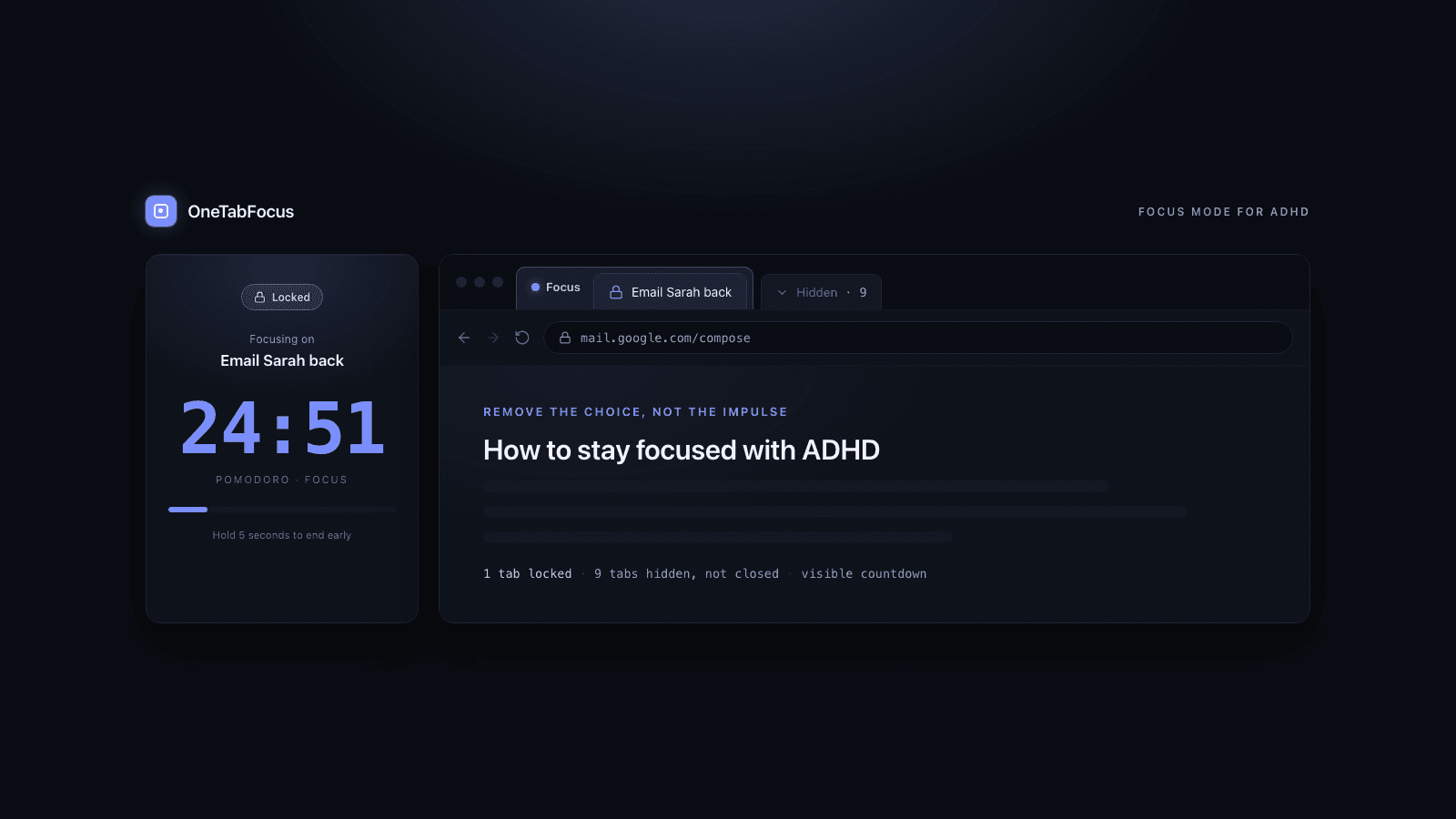
On this page
- Why willpower is the wrong tool for ADHD focus
- Environment design that works with the ADHD brain
- 1. Lock the choice, not the impulse
- 2. Use a 25-minute Pomodoro (it's short enough to start)
- 3. Body-double when you can
- 4. Make the timer visible
- 5. Let your body do what it needs
- The tactics that come second (sleep, exercise, medication, mindfulness)
- How OneTabFocus helps
Why willpower is the wrong tool for ADHD focus
Every health publisher on the internet — Cleveland Clinic, ADDA, Memorial Hermann, UChicago Medicine — lists roughly the same seven to nine ADHD focus tips: take breaks, exercise, fidget, eat well, use timers, get organised, meditate. Most of it is medically sound. None of it names the thing that makes ADHD focus actually hard, and none of it tells you what a real Chrome focus mode for the ADHD brain looks like.
The mechanism is dopamine. The ADHD brain runs on a lower baseline level of dopamine, and the result is that attention is preferentially pulled toward whatever delivers a quick dopamine hit. That includes novelty — anything new, surprising, or interesting. A 2022 peer-reviewed review of stimulus-dependent dopamine release in ADHD lays this out in detail: the ADHD brain is doing exactly what its wiring asks it to do when it switches from a tax return to a Twitter tab. The interesting thing is interesting to your wiring, not just to you.
This is why willpower keeps failing. Willpower asks you to suppress the dopamine-seeking response using cognitive effort the ADHD brain has less of to spend. You can do it for ten minutes, twenty if you're caffeinated, and then your prefrontal cortex runs out and the next tab wins. The fix that actually works is to stop asking willpower to do the work and instead change what your brain is being asked to do. That is what people mean by environment design, and it is what a Chrome focus mode built for the ADHD brain is for: not a guilt trip, just fewer choices.
The rest of this post is five tactics ordered by how much they lean on environment over willpower.
Environment design that works with the ADHD brain
1. Lock the choice, not the impulse
If you change exactly one thing about how you work, change this. Lock the browser to the tab you're trying to work in, plus a small set of reference tabs you actually need, for a fixed duration. Not a blocklist that you can disable in two clicks — a real lock that holds for the session.
The reason this works for ADHD specifically: the dopamine-seeking response is triggered by the presence of the novel option, not just the act of switching. A 2017 University of Texas study on the mere presence of a smartphone found that the device sitting silent and face-down on the desk reduced measurable cognitive performance, because part of attention was spent on the active suppression of thinking about it. Open browser tabs work the same way for an ADHD brain — every tab in the tab strip is a tiny dopamine candidate, and the cost of not clicking them is real. Lock them away and the suppression cost goes to zero.
This is not about discipline. It is about reducing the surface area your prefrontal cortex has to defend.
2. Use a 25-minute Pomodoro (it's short enough to start)
A Pomodoro is 25 minutes of focused work followed by a five-minute break.
The Cleveland Clinic recommends Pomodoro for adults with ADHD specifically, and the reason has nothing to do with the 25-minute number being magic. The 25-minute window is short enough that an ADHD brain can commit to starting, and starting is the part that fails. "Write the report" is a vague open-ended commitment your brain can defer indefinitely. "Write the report for 25 minutes, then take a five-minute break" is a concrete time-bound game, and your brain can play games.
The visible countdown matters too. A timer you can see converts abstract progress into a moving line, which is the kind of feedback the ADHD brain reliably notices and responds to.
3. Body-double when you can
Body doubling is doing your work in the presence of another person — same room or video call — while each of you works on your own task. It is one of the most consistent recommendations across the ADHD community, both in Tiimo's resources for neurodivergent users and in clinical write-ups like Medical News Today's body-doubling overview.
Honest disclosure: there are no large randomised trials yet. The proposed mechanism is that the presence of another working person creates a quiet form of accountability, reduces hyperactivity, and models focused behaviour for the brain to mirror. The anecdotal evidence is strong and growing, but it is not yet RCT-level proof. If you have not tried it, the lowest-friction version is to open a Focusmate, Cofocus, or Discord coworking session — 50 minutes, camera on, no talking. Many ADHD adults report it is the single thing that makes them able to do paperwork.
4. Make the timer visible
Cleveland Clinic's seven-ways list explicitly names "the right environment, a visual timer and a low level of stimulation" as a focus-supporting combination. The visual part is doing real work. The ADHD brain notices change-over-time more reliably than it notices static instructions, so a countdown ring or a shrinking bar is far more effective than an alarm at the end.
You do not need a fancy device. A kitchen timer, a phone Pomodoro app, or — usefully — a browser extension that runs the timer next to the tab you're working in does the job. The point is that the timer is visible, not hidden behind a notification.
5. Let your body do what it needs
The fidget research is real. Cleveland Clinic and ADDA both name fidgeting as therapeutic, not as a distraction — small, repetitive movement gives the seeking system something to attend to, freeing the rest of attention for the actual task. Quiet movement counts too: pacing while reading, a foot-rocker under the desk, a standing-desk position change every Pomodoro.
This is the most-cited generic ADHD tip on every health publisher's listicle, and it is genuinely supported. Treat it as a second-order tactic that makes the first four work better, not as the central fix.
The tactics that come second (sleep, exercise, medication, mindfulness)
The broader picture matters. Sleep deprivation makes every ADHD symptom worse, exercise raises baseline dopamine and improves executive function for hours afterward, mindfulness meditation lengthens sustained-attention windows over weeks of practice, and medication — when prescribed and managed by a psychiatrist — adjusts the underlying neurochemistry directly. None of this is optional in a complete picture of ADHD management.
It is also not what makes the difference between a focused work block and a lost one. A medicated, well-rested, mindfulness-practising ADHD adult is still going to lose a 25-minute window to a Chrome tab if every Chrome tab is one keystroke away. Generic advice optimises the brain; environment design fixes the workday. Both matter. Start with the workday.
How OneTabFocus helps
OneTabFocus collapses every non-focus tab into a single 'Hidden' chip. Tabs are not closed: audio keeps playing, drafts are preserved, scroll position is preserved.
Pomodoro mode runs configurable focus and break cycles. The lock holds through breaks — you get a pause screen, not a return to distraction. The focus phase resumes automatically.
For ADHD specifically, the value is the combination: the lock removes the dopamine-seeking trigger by hiding the other tabs entirely, the visible countdown gives your brain the change-over-time signal it needs to stay oriented, and the 25-minute Pomodoro default is short enough to commit to starting. If you want the deeper mechanics, see the Chrome focus mode page or the Pomodoro page. Otherwise, install OneTabFocus and run one 25-minute session on whatever you've been avoiding today.
FAQ
Does Pomodoro work for ADHD?
Yes. The 25-minute Pomodoro window is short enough for an ADHD brain to commit to starting, which is the actual hard part. The visible countdown converts an abstract task into a concrete time-bound game, and the Cleveland Clinic explicitly recommends Pomodoro for adults with ADHD. Start at 25 minutes and only stretch longer once the short cycle feels easy.
Why do I keep switching tabs?
Tab switching is a dopamine-seeking response, not a willpower failure. ADHD brains have lower baseline dopamine and preferentially attend to novelty over importance, so the new tab is doing what novelty is wired to do — pulling your attention. Reducing the number of reachable tabs is more effective than willpower because it removes the trigger before willpower has to fire.
What is body doubling?
Body doubling is doing your work alongside another person, in the same room or on a video call, while each of you works on your own task. It creates a quiet form of accountability that the ADHD brain responds to. There are no large randomised trials yet, but anecdotal evidence across the ADHD community is consistent and growing.
How long should an ADHD focus session be?
Start at 25 minutes — one Pomodoro. If you reach the timer with energy left, take a real five-minute break and run a second. Sessions longer than 45 minutes consistently work for some adults with ADHD, but they should be earned, not assumed. The goal is to start; the duration scales after the start is reliable.