
How to Focus With ADHD: A System That Holds
How to focus with ADHD without relying on willpower. Why your focus keeps breaking, and a simple setup that helps you start and finish one block of work.
 CollinFounder, OneTabFocus9 min read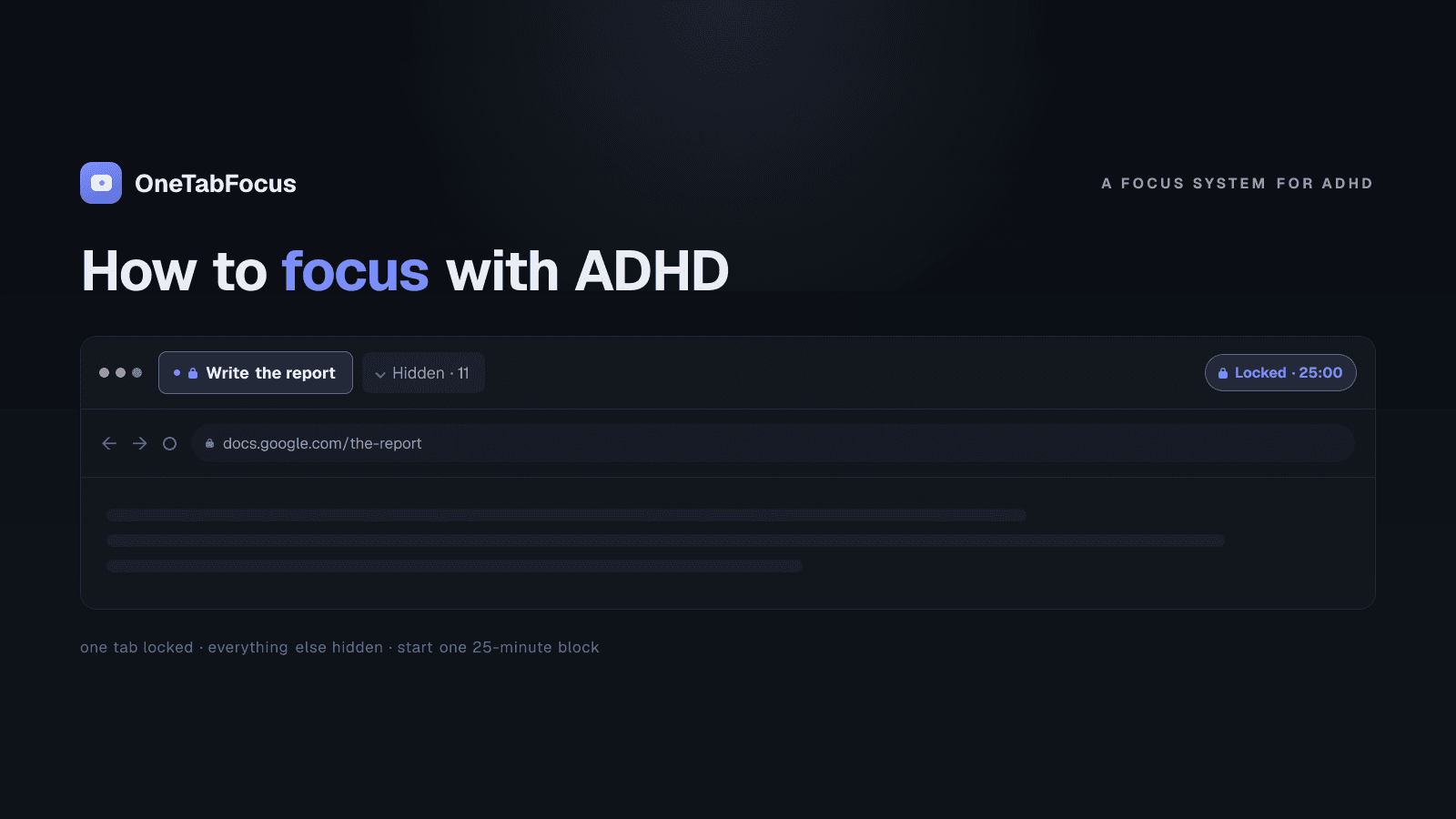
On this page
- Why focus is harder with ADHD (it's not laziness)
- The one idea: change your setup, not your discipline
- A focus setup for the ADHD brain
- 1. Lock away the thing you reach for most
- 2. Make the start small: 25 minutes
- 3. Keep the timer where you can see it
- 4. Borrow someone else's focus
- 5. Let your body move
- How to focus better with ADHD over time
- How to focus with ADHD without medication
- Where OneTabFocus fits
If you have ADHD and you've read one "how to focus" article, you've basically read them all. Take breaks, drink water, use a timer, get organised. Most of it is true. Almost none of it tells you why focus falls apart for an ADHD brain, or what to actually do at 2pm when the report is due and you somehow have eleven tabs open.
This is the version that explains what's going on, then gives you a setup built around it. The short answer is at the top of the page: change your setup, don't just try harder. Here's the longer one.
Why focus is harder with ADHD (it's not laziness)
Here's the simple version. Your brain is wired to go after whatever feels new or interesting, because that gives it a little hit of dopamine. A new tab is the easiest hit there is. So when you flip from a boring tax form to something shiny, your brain is doing exactly what it's built to do. (If you want the research, this review of dopamine and ADHD lays it out.)
That's also why willpower keeps losing. Willpower asks you to fight that pull using effort an ADHD brain has less of to spend. You can hold out for ten minutes, maybe twenty with coffee, and then the next shiny thing wins. The fix isn't more willpower. It's needing less of it.
The one idea: change your setup, not your discipline
Every tip below is the same idea in different places: get the distraction out of reach before willpower has to step in. Distraction is easiest to beat when it never reaches you in the first place. Once the tempting thing is on screen, you've already lost most of the fight. A 2017 study found that even a silent phone sitting face-down on the desk made people perform worse, just from the effort of not checking it. Open tabs work the same way. The win is in the setup, not the struggle.
A focus setup for the ADHD brain
1. Lock away the thing you reach for most
For most of us at a computer, that's the browser. So lock it. Not a blocklist you can switch off in two clicks. A real lock that holds you to the one tab you're working in (plus any you genuinely need) for a set time.
This is the biggest lever, because it kills the temptation at the source. With the other tabs hidden, there's nothing to reach for. See how it works on the focus mode for Chrome page, or how the tab lock itself works.
2. Make the start small: 25 minutes
The hardest part of any task isn't doing it. It's starting. "Write the report" is the kind of open-ended thing you can put off forever. "Write the report for 25 minutes, then stop" is a small, clear game, and your brain can play games.
That's why the Pomodoro technique works so well for ADHD. The 25 minutes isn't magic. It's just short enough to say yes to. The Cleveland Clinic recommends it for adults with ADHD. Start one round on whatever you've been avoiding. You can always stop at 25.
3. Keep the timer where you can see it
An ADHD brain notices things moving and changing far more than it notices a quiet deadline. A countdown you can actually see keeps you on track in a way an alarm at the end never will. A timer hidden behind a notification does nothing. A timer in front of you does the work.
4. Borrow someone else's focus
Working next to another person, in the room or on a video call, while you each do your own thing, is one of the most recommended ADHD tricks there is. The quiet sense that someone's there keeps you honest, even when nobody says a word. The easiest way to try it is a Focusmate session: 50 minutes, camera on, no talking. For more on this and the tips above, read how to stay focused with ADHD.
5. Let your body move
Fidgeting helps, it's not a distraction. Small, repeated movement gives the restless part of your brain something to do, so the rest of you can stay on the task. A foot-rocker, a stress ball, pacing while you read, standing up every round. Treat movement as the thing that makes the other four work better.
How to focus better with ADHD over time
One good block is a win. The real win is doing one most days. You're not aiming for a heroic six-hour stretch. You're aiming for one solid block a day that you actually keep, because that's what teaches your brain that focus has a shape: a start, a timer, and an end.
This is where a streak and a bit of session history help. They turn an invisible habit into something you can see and don't want to break. Once the short block feels easy, you can stretch it. That's deep work territory. Just earn the longer block, don't assume it.
How to focus with ADHD without medication
A lot of people come here looking for exactly this, so let's be straight about it.
Changing your setup, like hiding the distraction before it can grab you, helps whether or not you take medication, because it fixes your workday rather than your brain chemistry. Even someone who's medicated, well-rested, and exercised will still lose 25 minutes to a browser tab if every tab is one click away. So these tips are useful to everyone, on meds or off.
What this page is not: medical advice, or a replacement for treatment. Medication, therapy, and diagnosis are things to sort out with a doctor. That's a separate layer from how you set up your desk. Use your setup to fix the workday, and a professional to make the medical calls. Both matter.
Where OneTabFocus fits
OneTabFocus is the tool for step #1, built around this whole idea.
OneTabFocus is made for the way ADHD works. When you can't stop reaching for a new tab, that's not a willpower problem. So instead of asking you to resist, OneTabFocus locks the tab away until your timer is done.
OneTabFocus tucks every other tab into one hidden group. Nothing gets closed. Your audio keeps playing, and your half-typed text and scroll position stay put.
Pomodoro mode runs focus and break cycles you set yourself. The lock stays on through breaks, so you get a calm pause screen instead of a wide-open browser. The next focus round starts on its own.
Want the details? Read the focus mode for Chrome page, or see how it stacks up in the best ADHD apps for adults. Otherwise, install OneTabFocus and run one 25-minute block on the thing you've been avoiding today. That's the whole setup: one block, started.
FAQ
Why is it so hard to focus with ADHD?
Your brain is wired to chase whatever feels new or interesting, because that gives it a little hit of dopamine. A fresh browser tab is the easiest hit there is. So it isn't laziness and it isn't a character flaw. Your attention is doing exactly what it's built to do.
How can I focus better with ADHD over time?
Stop trying to win the whole day on willpower and stack small wins instead. Do one short, defended block of focus a day, keep the timer where you can see it, and track the streak. It gets easier to start once your brain trusts the block has a clear beginning and end.
How do I focus with ADHD without medication?
Changing your setup, like hiding the distraction before it can grab you, helps whether or not you take medication, because it fixes your workday rather than your brain chemistry. It is not a replacement for treatment, though. Medication and diagnosis are decisions to make with a doctor.
Does the Pomodoro technique work for ADHD?
Yes. Twenty-five minutes is short enough that you can talk yourself into starting, and starting is usually the hard part. A timer you can watch turns a vague task into a small, clear game. The Cleveland Clinic recommends Pomodoro for adults with ADHD.